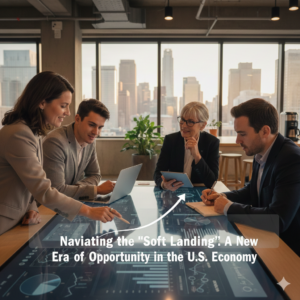
Navigating the "Soft Landing": A New Era of Opportunity in the U.S. Economy
Strategic Insights for Building Wealth as Inflation Cools and Markets Stabilize
Understanding the Modern Economic Landscape: An Introductory Overview
The U.S. economy is currently navigating one of its most complex and fascinating chapters in decades. Following a period of historic inflation and aggressive interest rate hikes by the Federal Reserve, the narrative has shifted from “recession fears” to a “soft landing.” This transition represents a delicate balancing act where economic growth remains positive, the labor market stays resilient, and price increases finally return to manageable levels.
For the modern investor, this isn’t just a headline; it is a fundamental shift in how capital should be deployed. We are moving away from a high-volatility, “crisis-management” environment into a phase of calculated growth. Understanding the mechanics of the U.S. GDP, the nuances of consumer spending power, and the Federal Reserve’s future trajectory is no longer optional—it is the bedrock of financial literacy. This summary explores how these macro forces interact to create a unique window of opportunity for those who can read the signals before the broader market reacts.
The Resilience of Growth: Why the "Soft Landing" is Your Greatest Financial Ally
The term “soft landing” was once whispered with skepticism in the halls of Wall Street, but today, it stands as the primary driver of market optimism. In essence, the U.S. economy has managed to curb inflation without triggering a massive spike in unemployment—a feat many economists thought impossible just eighteen months ago. This resilience is largely attributed to a robust service sector and a surprising surge in productivity driven by technological integration.
As we look at the data, the consumer remains the backbone of the American economy. Despite higher borrowing costs, household balance sheets have shown remarkable durability. For investors, this environment creates a “Goldilocks” scenario: the economy is not too hot to trigger more rate hikes, yet not too cold to slide into a recession. This stability allows for better long-term planning. Instead of hoarding cash in fear of a crash, smart money is now rotating into sectors that benefit from stabilized rates, such as real estate, mid-cap equities, and sustainable energy.
Furthermore, the cooling of the Consumer Price Index (CPI) means that real wages are finally starting to grow. When people earn more than the cost of living increases, discretionary spending rises, fueling corporate earnings across the board. The ripple effect is clear: a stabilized U.S. economy provides a fertile ground for compound interest to do its best work. By aligning your portfolio with these stabilizing trends, you aren’t just surviving the economic cycle; you are positioning yourself to thrive in the expansion that inevitably follows a period of contraction. The window to capitalize on this transition is narrow, as markets tend to price in these “landings” well before they are officially declared.
Unlocking Prosperity: The Strategic Upside of a Stabilizing Economy
Why Now is the Golden Window for Smart Capital Allocation
The Power of the “Wealth Effect”: Did you know that as home values stay high despite interest rates, many Americans feel wealthier and continue to spend? Tip: Look into REITs (Real Estate Investment Trusts) that focus on high-demand residential areas to ride this wave of equity growth.
Election Year Echoes: Historically, the U.S. stock market tends to perform well in the year following a major election cycle as policy clarity emerges. Tip: Don’t let political noise distract you; maintain a long-term “buy and hold” strategy during these shifts.
The “Yield Lock” Strategy: With the Fed expected to hold or slowly cut rates, fixed-income assets like Treasury bonds offer a rare chance to lock in high yields before they disappear. Tip: Diversify your “boring” assets now to enjoy high-interest payouts for years to come.
AI Productivity Boost: We are seeing the first real signs of AI impacting GDP through increased worker efficiency. Curiosity: Companies that adopt AI early are seeing profit margin expansions without increasing prices. Tip: Look for “old economy” companies (like manufacturing or logistics) that are successfully integrating tech, not just the tech giants themselves.
The Calculated Risks: Navigating the Shadows of Market Stability
Understanding the Trade-offs Without Losing Your Competitive Edge
The “Lag Effect” Patience Test: One significant disadvantage of following economic tips is the “lag effect.” Monetary policy changes can take 12 to 18 months to fully manifest in the real world. This means that even if you make the “right” move today based on a Fed rate pause, your portfolio might feel stagnant for a few months. However, this isn’t a sign of failure; it’s simply the economy’s internal clock at work. Successful investors view this delay as a “loading screen” before the next growth phase, allowing them to accumulate more assets at steady prices while others get bored and exit too early.
The Opportunity Cost of Safety: In a stabilizing economy, the biggest “risk” is often being too cautious. By locking into high-yield bonds or “safe” savings accounts to capture current rates, you might miss the explosive early-stage growth of the next bull market in equities. While this “disadvantage” means you might not hit the absolute peak of a stock market rally, it provides a crucial safety net. It’s the price you pay for sleeping well at night—trading a small percentage of potential “moonshot” gains for the guaranteed stability of a well-balanced, resilient financial foundation.
Our Post

Credit Cards and More Credit Cards: How Debt Can Become a Dangerous Cycle

Is It Possible to Invest Without Knowing Anything About Investing?